
The Thurmont Trolley Trail
The Thurmont Trolley Trail in Thurmont offers visitors more than a scenic place to walk; it serves as a living reminder of a once-vital transportation system that helped shape Northern Frederick County. The trail occupies the right-of-way of the Hagerstown & Frederick Railway, whose electric trolleys and freight operations were central to the life of the Thurmont region from the early 1900s to the mid-1950s.
The roots of the railway system go back to several small rail and trolley companies in the late 19th century. One early segment, built as a steam railroad, ran from Catoctin Furnace to Thurmont and connected to the Western Maryland Railroad. By 1908, the line was electrified, and in 1913, the various pieces were integrated into the Hagerstown & Frederick Railway, creating a network of approximately 87 miles of track. At its height in the 1920s, the line was thriving; in 1920, the Frederick-Thurmont route carried over 3 million passengers annually. But within two decades, patronage had sharply declined; by 1940, ridership had dropped to about half a million annually.
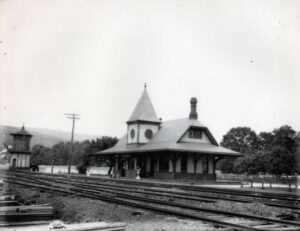
Photo of Thurmont Train Station taken by CK Beck ca 1890s. From the collection of THS.
For Thurmont, the arrival of the trolley in 1908 was a transformative event. It connected residents to Frederick and beyond, facilitating both the transport of people and the movement of goods. It enabled more efficient travel for everyday business, and also helped open the region to tourism; visitors could more easily reach the scenic Catoctin Mountains and other attractions. However, the mid-twentieth century brought increasing competition from automobiles. As roads improved and vehicles became more accessible, the trolley system struggled to keep up. The last passenger trolleys between Frederick and Thurmont ran on February 20, 1954, marking the end of one of Maryland’s last interurban trolley lines. Freight service continued for a while after the cessation of passenger service, though even freight would eventually decline.
After the rails were removed, the old line fell into disuse and gradually reverted to its natural state. In 2004, members of the Thurmont Lions Club initiated a community project to restore the former trolley corridor as a pedestrian and bicycle trail. Through more than 850 hours of volunteer labor, the group cleared brush, stabilized eroded stream banks, constructed bridges over Big Hunting Creek, and laid more than 1,800 tons of crushed stone to form a stable walking surface. Their efforts culminated in the trail’s dedication in 2007, re-establishing a physical connection along the same route once followed by electric trolleys. Additions such as picnic tables, benches, and landscaping followed, and the trail was paved in 2017. The project not only reclaimed a forgotten landscape but also honored a key chapter in Thurmont’s transportation heritage.
Today, the trail spans approximately one mile, running from East Main Street to East Moser Road, and includes the “Library Loop” extension that connects to the Thurmont Regional Library. Near the old trolley substation on Main Street stands one of the few surviving trolley cars, and murals along the substation walls recount the history of the trolley line.
The significance of the trail lies not just in its recreational value. Each plank, bench, and bridge is a reminder of the people who rode the trolley to work, to the market, to home; of the engineers, operators, and planners who built out the network; of the shift in how we move and live that made such systems fade. And yet, the revival of the trail also speaks to Thurmont’s capacity to reclaim its heritage, to honor what was, while using it to enrich lives today.