
The Thurmont Main Street Center
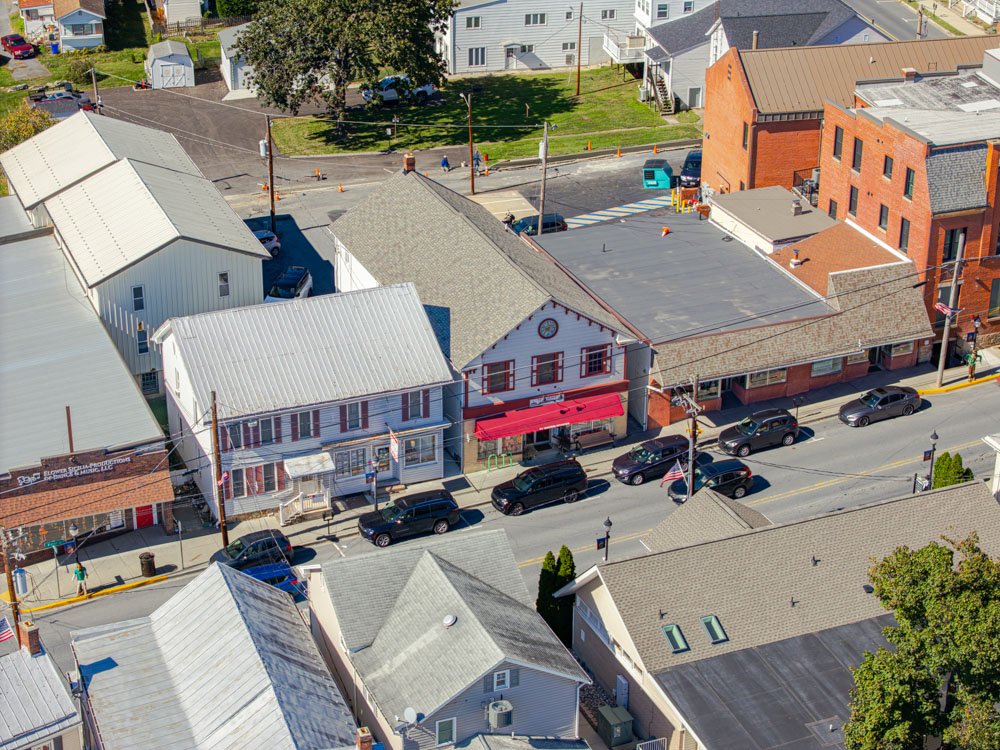
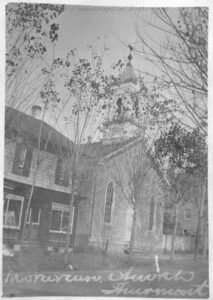
The Moravian Church on Water Street. This Building later housed Weybright’s store and is currently the home of the Thurmont Library. From the Hamrick postcard collection
The history of the 2-story building located at 11 Water Street begins in 1874. According to the records of the Graceham Moravian Church, a Congregational Council was convened on February 15, 1874 which resolved that there should be a permanent house of worship in Mechanicstown (aka Thurmont). As a result, a then vacant lot on Water Street (formerly known as South Street) was selected and a church was built. The cornerstone for the “Thurmont Moravian Church” was laid at 10:00 AM on Sunday, July 19, 1874 with Bishop David Bigler of Lancaster, Pennsylvania presiding. A time capsule was placed in the cornerstone at the time which included, among other things, a bible and copies of the former newspapers, the Catoctin Clarion and the German Messenger. The completed church building was dedicated on December 6, 1874. The architect for the building was Mr. John C. Trautwine (1810-1883) of Philadelphia; a well-known architect of the time. Mr. Trautwine worked on several railroads and canal projects throughout North and South America, and also was the designer of the First Moravian Church building in Philadelphia. The original Thurmont church building accommodated 300 persons and was regarded as one of the most beautiful church buildings in Mechanicstown. The exterior was painted a stone color. The steeple had a Troy bell; Troy bells were known for their sound quality (Troy bells were cast in the Clinton Meneely foundry located in Troy, New York). The cost of the building (including furnishings) was $2,400. The “Thurmont Moravian Church” served the community for 44 years. The last church service at this location was held on September 1, 1918. Due to declining membership at the Thurmont church and the proximity of the Graceham Moravian Church, it was decided by Church leadership to consolidate the membership of the two churches at the much older and much larger Graceham Moravian Church.
In 1918, the Board of Elders of the Northern Diocese of the United Brethren (i.e. the Moravian Church) sold the building to Daniel Saylor Weybright, a prominent citizen of Thurmont. D.S. Saylor made extensive renovations to the church building. In particular, Mr. Weybright removed the steeple, raised the building by 4 feet and dug out a basement.
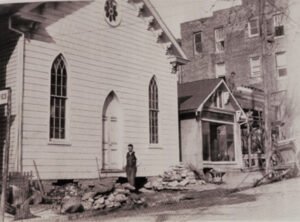
Photo Credit: “The Robert S. Kinnaird Collection of Historic Photographs”
He also added a suspended second story from the rafters by large wrought iron bolts. The church bell was donated by Mr. Weybright to a Moravian church in Staten Island, New York. Mr. Weybright owned the building immediately south of 11 Water Street (13 Water Street). He constructed a connecting below-ground passage between the basements of the 2 buildings and put in a street level stairwell between 11 and 13 Water Street which went down to the connecting passage. Although the lancet windows and arched doors were replaced, the rounded window and scrolled bracketing in the front gable remain.
Once the remodeling was completed, Mr. Saylor, together with Guy Hobbs and Lee Martin opened a grocery and farmers supply store at 11 Water Street. Shortly thereafter, Messrs. Saylor, Hobbs and Martin added a dairy to their business; the dairy was known as the Homarway Dairy – it was the first dairy to pasteurize milk in the area. Homarway gathered milk from local farmers, had a facility to pasteurize the milk and would deliver the pasteurized milk to customers. The name “Homarway” is a combination of the surnames of the three men – “Ho” is Hobbs (who had a grocery store in this building); “Mar” Lee Martin (who boiled and pasteurized milk in the basement); and “Way” – Daniel Saylor Weybright (who had a retail and feed store next door at 13 Water Street). Mr. Weybright also ran a local mill and farmer’s coop and had contacts with local dairy farmers. Homarway went out of business in 1932 and the business and building were sold to Carl S. Gall, Lottie E. Gall, Ross V. Smith and Pauline S. Smith. After the sale, the building became known as the “Gall and Smith Building”.
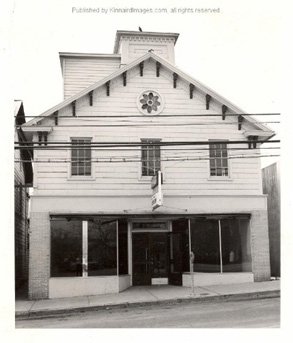
Photo Credit: “The Robert S. Kinnaird Collection of Historic Photographs”
Gall and Smith continued to operate a grocery store, feed and farm supply business and a dairy at 11 and 13 Water Street. In 1938, there was a devastating fire at the building. More than $8,000 in damage was done to the building and its contents. The building was substantially remodeled after the fire which included a 30 foot addition to the rear of the building, relocation of the stairwells and installation of structural glass to the front of the building. In 1940 Ross and Pauline Smith sold their interest in 11 Water Street to Lottie Gall. Carl Gall continued to operate the business until his death in 1956. There was an old stone jail behind the Gall and Smith Building but it was demolished in 1948 to allow for expansion of the Gall and Stone business. After Gall and Smith discontinued their business, the building was leased to the American Stores Company, a national grocery store chain, which operated a grocery store in the building until early in 1967 when its lease expired. The American Store originally opened in Thurmont in the 1940s (on W. Main Street) but relocated to 11 Water Street building after Gall and Smith closed their business.
After the American Store vacated the building, it was again remodeled and for a short-time made into a recreation center for teens known as “Teentown” or the “Thurmont Teen Center.” However, in April, 1968, Lottie E. Gall, the then owner of 11 Water Street, gifted the building to the Thurmont Public Library, Inc. At the time of the sale, the Thurmont library was located in a much smaller space on W. Main Street; a public library was first established in Thurmont in 1956. By 1968 the library had outgrown its space on W. Main Street and the Board of Trustees had determined to find a new site for the library. Lottie Gall was on the Board of Trustees for the library and she generously agreed to donate the building to the library. In 1968, a volunteer youth effort was organized to march the books from the location on W. Main Street to the newly renovated building on Water Street. Over 7000 books were moved by volunteers – the Jaycees, the Lions and Grange, Boys Scouts and Girl Scouts and 4-H’ers, organized by Ralph Fornwald. About $10,000 was spent renovating the building for the library. Grand opening of the new library occurred in late summer of 1968.
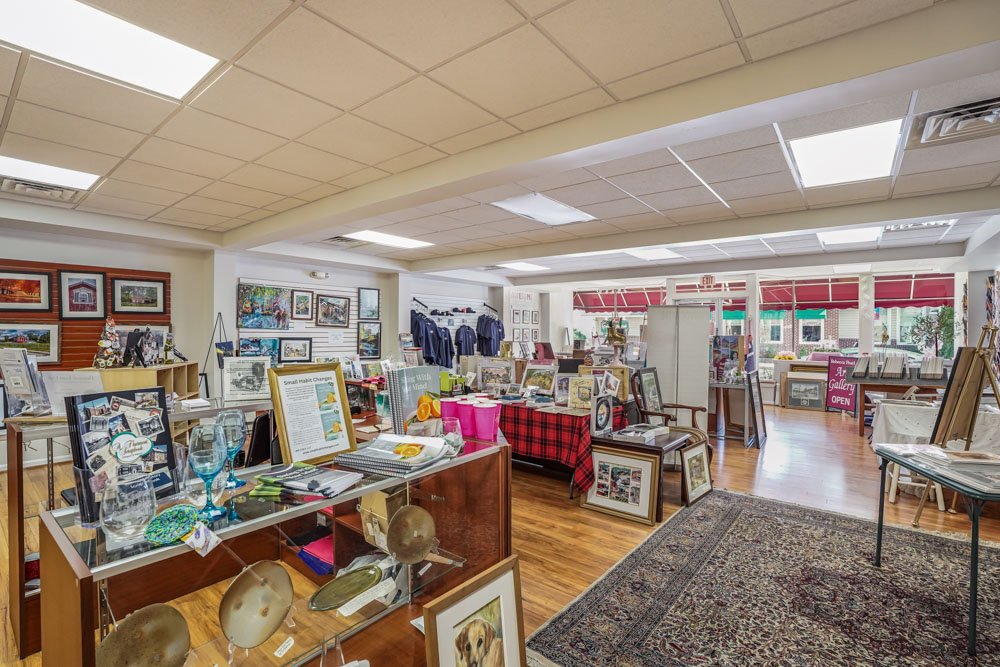
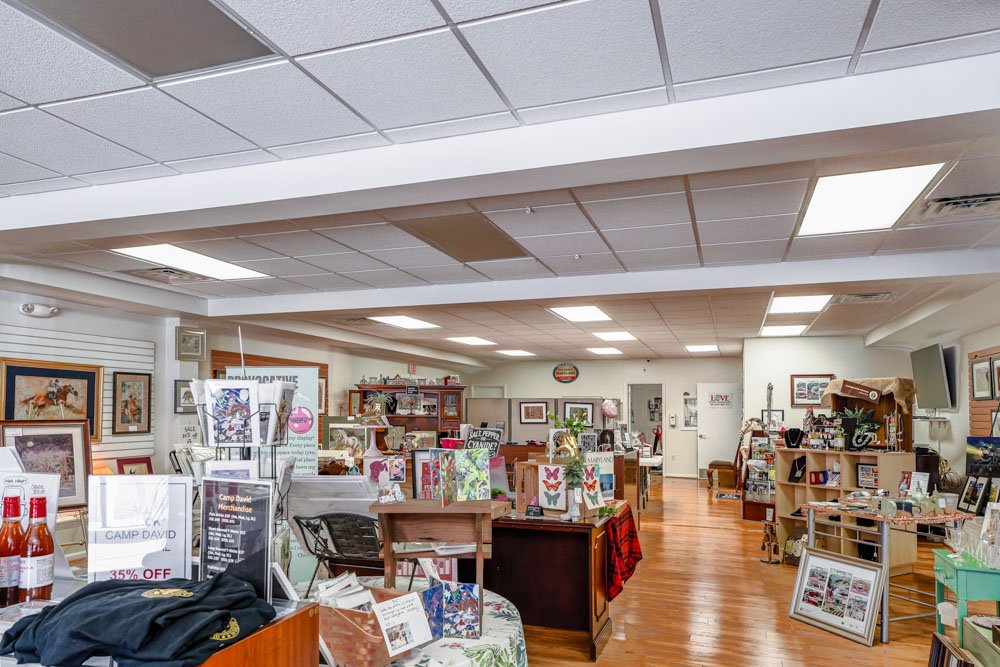
In 2011, the Thurmont Public Library, Inc. transferred the building to The Community Foundation Holding Company, Inc. as part of the dissolution of the Thurmont Public Library, Inc. A few weeks later, the Community Foundation sold 11 Water Street to the Town of Thurmont for $150,000. The building currently houses the Thurmont Main Street Center.