
The “Match House”
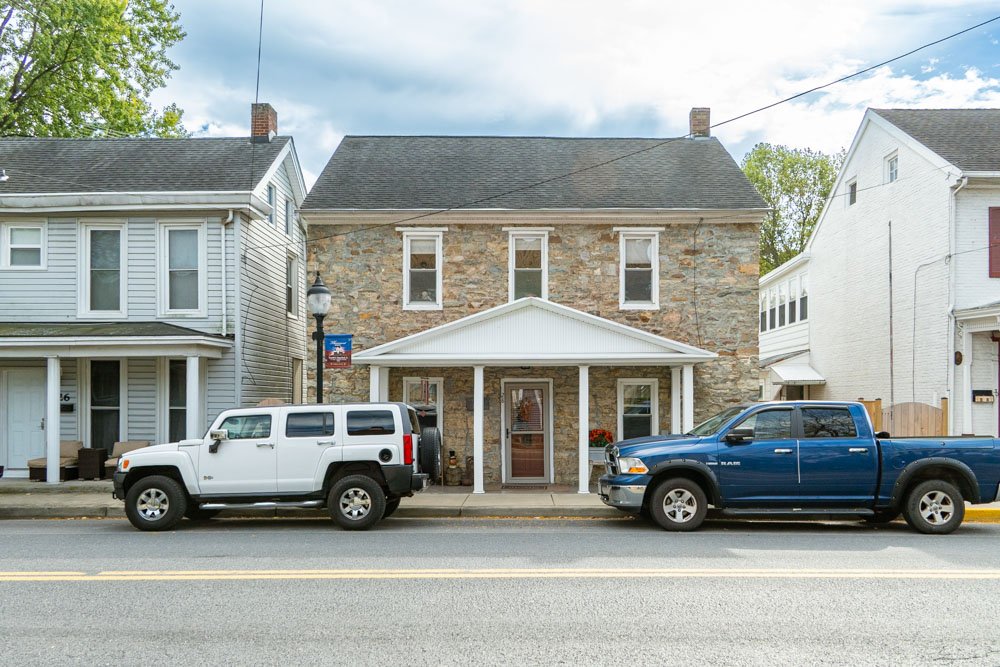
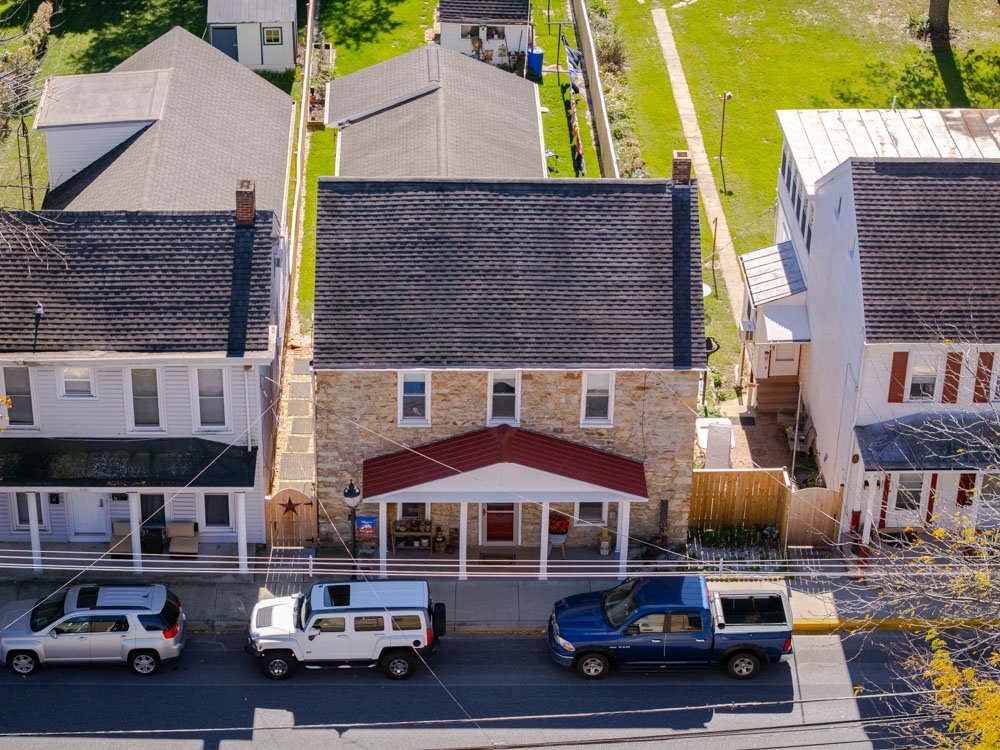
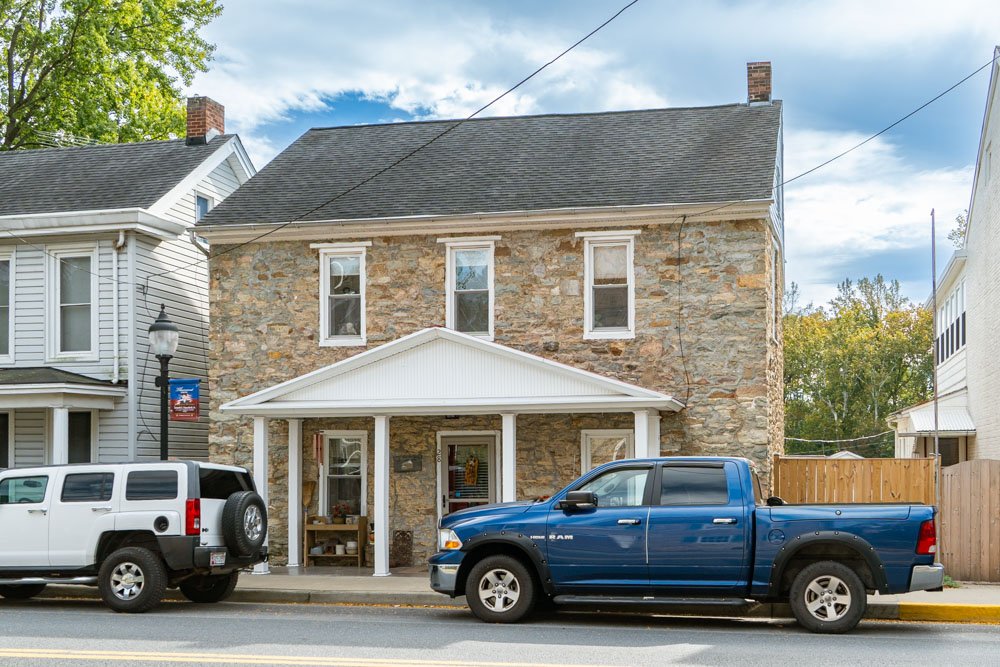
Jacob Weller (1775-1846) was a blacksmith and a grandson of Johannes Weller, a German immigrant and one of the founders of Mechanicstown (modern day Thurmont). Jacob Weller signed his name as “Jacob Weller B.S.” (aka blacksmith) to identify himself and his trade. Starting in 1805, Jacob Weller B.S. began purchasing lots in Mechanicstown. He purchased 2 lots on the north side of W. Main Street on which he constructed a large stone building (which still stands today and is 27 W. Main Street). This building was his family residence and an inn. In that same year, he purchased 2 acres on the south side of W. Main Street (lots 16, 17, 18 and 19). On this site, he built a 1-1/2 story limestone building with a peaked roof and most likely with a workshop at the rear.
The building located at 28 W. Main Street became known as the “Match House” because Jacob Weller B.S. is credited with the manufacture of the first “friction” or “Lucifer” matches in the United States starting in 1825. The story is that while in Frederick, Jacob Weller purchased some friction matches imported from France. He and his brother, Joseph, then set about to learn how to manufacture these amazing matches. Although today, we take for granted the mass production of matches, in the early 19th Century matchmaking could be a dangerous endeavor. There were several explosions at Jacob Weller’s matchmaking site. These early matches were sometimes called “lucifers” in part because there was some superstitious fear about a stick that could light a fire. Jacob and his brother, Joseph, peddled the matches throughout Frederick County at 25 cents a box.
Unfortunately, Jacob Weller failed to patent his “invention” and soon there were multiple copycat manufacturers. The first patent for a friction match granted in the United States was granted in 1836 to a man in Massachusetts. Sadly by the 1830s Jacob Weller was financially insolvent; all of his properties, including the Match House, were sold off to pay off his creditors in 1835. Despite his financial ruin, Jacob Weller remained a respected and notable resident in Thurmont. Prior to his financial ruin, he had donated land for the construction of a church – originally the Weller’s United Brethren in Christ Church and today’s Weller United Methodist Church.
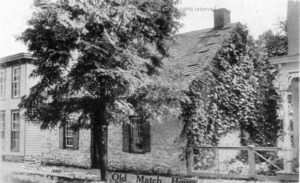
From a postcard copyrighted 1910. Showing the building before the addition of the second story. Photo Credit: “The Robert S. Kinnaird Collection of Historic Photographs”
Fortunately, the “Match House” survived and is now a private residence. Over the years beginning in the early 20th Century, however, several alterations were made to the original stone building; these alterations disqualified the Match House from being eligible for listing on the National Register of Historic Places. In particular, after purchasing the Match House in 1910 for $750.00, Rudolph Eyler raised the stone walls to convert the building to a 2-story residence and added a cellar. Mr. Eyler owned an adjoining house to the Match House at the time of his purchase of the Match House. It is said that Mr. Eyler regretted the changes he made to the old Match House but he remained the owner until 1953. Nevertheless it remains an important part of Thurmont’s history. The current owners are John and Susan Baugher who have owned the house since 1999. Mr. and Mrs. Baugher were not aware of their home’s historical significance until after they had purchased the home.
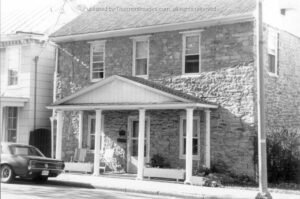
Showing the Old Match House in the 1970s. Notice the addition of the second story. Photo Credit: “The Robert S. Kinnaird Collection of Historic Photographs”