
CHAPEL INTERACTIVE VIRTUAL TOUR
Case Study & Press Kit
The Paradise Chapel Virtual Tour is a digital preservation project that brings one of Catonsville’s most historic landmarks to life through an immersive, interactive experience. Using high‑resolution imaging, careful documentation, and thoughtfully crafted interpretive content, the tour allows visitors to explore the chapel’s architecture, artifacts, and stories from any device.
This project was created as a fully built, on‑spec demo to expand access, support cultural heritage education, and provide the community with a modern way to engage with a site that holds important historical significance.
Paradise Chapel was originally built as Paradise Presbyterian Church and later known locally simply as “The Chapel” is currently an event space located at 600 Frederick Rd, Catonsville, MD 21228
VIEW AND SHARE THE DEDICATED TOUR PAGE
PROMO DEMO VIDEO
SEEKING COLLABORATORS
With additional investment and collaboration, this project can grow into a richer public resource for history, arts, education, and community engagement. We are seeking to partner with interested organizations and grant programs. We can expand this project with:
- Additional research, development, content, information, or tour focus at the funding organization’s discretion.
- AI-assisted content, including text and voiceover, can be edited, revised, or re-produced by experts and professionals.
- Accessibility and multi-language feature support.
- Purpose-built website or home on the web separate from Catapult Virtual Spaces page
- Polish and bug fixing
- Improved mobile experience
- Produce and install physical kiosk at location
ABOUT THE CREATOR
 Catapult Virtual Spaces is led by Dan Adler, a Catonsville‑based visual technologist focused on creating immersive digital experiences for historic, cultural, and community spaces. Dan combines technical expertise in 3D capture, drone imaging, and interactive design with a deep interest in local history and preservation.
The Paradise Chapel project grew out of a desire to document meaningful places in Catonsville and make them accessible to a wider audience through modern visualization mediums such as interactive virtual tours, self-guided GPS app tours, video, photography, and more.
KEY FEATURES
Narrated Timeline Mode & Freeform Explore Mode
Visitors can begin with a guided, two‑minute narrated sequence that moves fluidly through the exterior and interior of the chapel, highlighting key architectural details and historical moments referenced in the voiceover. After the narration, users can switch to Explore Mode, where they control their own viewpoint, jump between points of interest, and discover additional text, images, and interpretive content throughout the structure.
Seamless 3D and 360° Panorama Integration
High‑resolution 360° panoramas are seamlessly linked with a detailed 3D model, giving users complete freedom to navigate the chapel from any angle and explore both interior and exterior spaces with natural, intuitive movement.
Organ Performance Video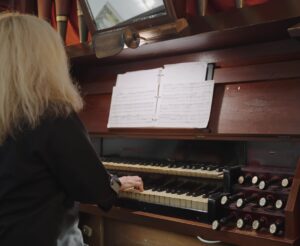
The chapel’s historic pipe organ, one of its most significant interior features, is showcased through a recorded performance by a skilled organist. The video offers both music and a rare look into the inner workings of the instrument from the inside, viewed directly within the virtual space.
Informational Popups and Interpretive Text
Key locations and architectural features include optional popups containing concise interpretive text, providing historical context, design significance, and insights into the chapel’s unique elements.
3D Artifact Scan and Display
Users may view historic artifacts, 3D scanned and placed in the tour. Rotate to view from all directions.
PROCESS

Collaboration with owners
The chapel’s owner contributed a small set of historical documents, granted permission for exterior drone capture, and provided interior access for one afternoon. Using these materials, we planned a focused capture session that documented all important architectural and historical features. After the session, we handled the research, writing, and design of the virtual tour, drawing primarily from the documents the owner shared. The owner reviewed written content and test versions at key points in the project. The entire workflow was designed to require very little time or effort from the owner while still ensuring accuracy and quality. Total owner involvement amounted to only a few hours across the entire project.
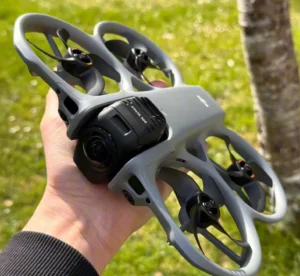
Drone capture inside and out
Two detailed 3D Gaussian Splat models were created for the project. One model represents the exterior of the chapel and the other represents the interior, which is featured in the narrated Timeline Tour. These models were produced by flying a drone equipped with a 360 camera in slow, controlled passes around and inside the building. Specialized photogrammetry software processed thousands of images and movement paths to generate detailed 3D environments. The drone used is a closed propeller design and is flown carefully to ensure complete safety inside historic spaces. Additional still photographs and video footage were captured both on foot and by drone to support the interpretive content.

360 Panorama capture
Interior viewpoints were documented using high resolution 360 panorama techniques. Most panoramas were captured with a professional mirrorless camera mounted on a precision panoramic tripod head. This method produces clear, distortion free spherical images that allow visitors to explore the chapel interior with exceptional detail.

Designing the Tour and Visitor Flow
The tour was designed to create a clear, intuitive experience that blends guided storytelling with open exploration. The process began by identifying the chapel’s most meaningful architectural and historical features and determining how visitors should encounter them. A short narrated introduction provides essential context, and the experience then opens into a free‑explore mode where visitors can move at their own pace and discover additional details.
Each viewpoint and point of interest was placed with intention so visitors naturally encounter important features without feeling directed. Interactive text, images, and popups were added only where they enhance understanding. Smooth transitions between 3D models and 360 panoramas ensure the experience feels cohesive, and the interface remains simple so the chapel itself stays at the center of attention.
The final result is a fully interactive web application that runs directly in modern browsers on phones, tablets, and computers. No app installation is required, which makes the experience easy to access and simple to share with the public.
PRESS
PRESS MEDIA
LINKS & QR
SPECIAL THANKS
Thank you to Kirby Spencer, owner of The Chapel for granting access, providing historical documents, and allowing capture. Thank you to Jane Bowie for volunteering to provide organ performances to be captured for the tour.